Mold loves moisture. It’s why you may see it in places like attics or basements, growing along the damp walls or along beams where humidity gets trapped and can’t escape. Which is precisely why you may wake up one morning to find mold growing in your cigar humidor as well.
It's no secret that cigars need a certain level of humidity to stay in good smoking shape. If their environment gets too dry, the cigars dry out too. The tobacco oils that give a cigar rich flavors, an oily sheen, and unique aromatics will evaporate if there is not enough humidity present. However, if a humidor gets too moist and isn’t ventilating properly, mold can form, turning what was once a premium cigar blend into a mushy, foul-tasting lump of rotten leaves.
So, if you’re here and you’ve found some mold growing under the lid of your cigar humidor, fear not. A moldy cigar humidor can oftentimes be saved if treated in a timely fashion, but only if you heed the following advice and perform the appropriate decontamination processes. Let's get to it, shall we?
How a Humidor Can Quickly Become a Breeding Ground for Mold

As we mentioned above, mold loves moist, humid environments. Given that a humidor is built to retain and maintain certain levels of moisture so that cigars can be safely stored for prolonged periods of time, a certain level of humidity must be held at all times. Further compounding the matter is the fact that mold tends to form on organic surfaces like wood rather easily. This explains why it is so important to have a humidor that is lined with real Spanish cedar, as it serves as a natural humidity regulator and is not nearly as prone to forming mold as other kinds of wood.
Even then, it's paramount that your humidor can maintain the right level of humidity, and if possible, the appropriate temperature as well. Ideally, your humidor should hold steady somewhere between 65–72% humidity year-round. Some fluctuation above or below these thresholds may occur, but as long as they return to normal after a few days, you should be golden.
However, to do so, a humidor must be able to "breathe." Meaning that the wood lining must effectively absorb and exhale moisture, thus encouraging the cigars to do the same. This is how something called "relative humidity" (RH) is achieved and maintained, and why certain cigars can be conditioned/aged for years, or even decades on end.
But sometimes these same environments, and the humidification systems that keep them more moist than dry, can cause humidity levels to rise to the over-saturated mark.
When your humidor’s humidity rises above 75%, the risk of mold forming increases exponentially. Similarly, if a humidor is stored in an environment where the temperature is regularly above 77°, mold spores are far more prone to finding a foothold.
Once you combine a moisture-rich, closed-loop environment with poor air circulation, high internal temperatures, and supple organic matter, it becomes only a matter of time until mold begins to form. More often than not, the cigars inside of a humidor will show signs of the stuff sooner than the humidor itself, for their supple nature makes them far more absorbent and therefore susceptible to the stuff.
If you are lucky enough to catch the outbreak in time, you might be able to quarantine those contaminated sticks, thereby snuffing out any chance of mold further spreading. But if left unchecked, those mold spores stand a damn good chance of taking over the entirety of the humidor, which is precisely why acting quickly and following the steps below is vital to saving your remaining cigars and the humidor itself.
How to Identify Mold in a Cigar Humidor

If you open your cigar humidor, only to find a spot of mold forming in a corner somewhere, don’t fret. It’s certainly not an ideal situation, but it isn't an absolute catastrophe either. You'll just have to put in a splash of additional work, and maybe cough up a little bit of coin.
But before you start to freak out, you might want to determine whether you even have mold in the first place. Sometimes, a little bit of lint that fell off your sweater while you were pulling out a stogie can look a lot like a fuzzy blob of mold to the untrained eye. So best to start by inspecting your smokes, and not just the humidor itself. Do you see growth on your cigars? If so, what color is it? It’s likely either white, blue, or green.
If you see a white, crystallized powder forming on the sides of your cigars, that's what is commonly called "cigar plume," or "bloom" in the cigar biz. While there is a ton of debate out there regarding whether plume is mold or not, every cigar maker we have spoken to on the subject, as well as other tobacco publications, agree that it is a naturally occurring stage in the aging process and not dangerous in any way.
Like the bumpy "teeth" that form on a cigar after it has been aged for a lengthy period of time, plume forms when the naturally occurring oils and sugars within cigar tobacco evaporate outward, eventually reaching the wrapper. As they dry on the outside of the cigar, these oils crystallize, at which point they become what is commonly known as plume. Unlike mold, which tends to form in concentrated spots, plume is far more evenly dispersed, and will oftentimes glisten in the light.
Don't like the looks of a white powder-covered cigar that appears to have been rolled on Tony Montana's desk? Just wipe it off and fire that stick up. If it is indeed plume, the powder will easily wipe away and not leave behind any sign of its existence.
"Plume, which is also called bloom, is a naturally occurring phenomenon in the cigar aging process. Oils that exude from the tobacco in a finished cigar will appear as a fine white powder and can be brushed off without leaving a mark. Plume is not to be confused with mold, which has color to it and stains the wrapper."—Cigar Aficionado
That said, there is a fine line between mold and plume, especially in an overly moist humidor, and it doesn't take much for the bad to take advantage of the situation by hiding alongside the good. If you try to wipe that plume away and it leaves a stain on the cigar’s wrapper, or there is a discoloration in the color of the plume that is anything other than white, chances are you’ve got humidor mold on your hands. At which point it is probably best to take the following humidor mold removal steps.
How to Treat Mold in a Cigar Humidor

So now that you know for a fact that you’ve got a mold issue, it's time to protect those stogies and get them the hell out of there. If a cigar looks moldy, it is best to throw it out. Respiratory infections blow, and moldy cigars taste like ass, so don't take a chance on a moldy stogie and throw that stick out.
Moldy smokes headed to the incinerator; it's time to place the remaining uncontaminated cigars in quarantine. A hard shell plastic food storage container with a locking gasket lid serves as an excellent temporary storage vessel, and will allow you to assess your smokes with ease in case any mold pops back on the scene.
Now, as for the mold in your humidor, taking a clean toothbrush or a small painter's brush to any visible mold should be enough to dislodge it from its growing environment. Mold scraped off, snag up the vacuum and suck that gunk up. If you don't already have a dedicated cigar vacuum, now might be the time to snag one. They are small, easy to operate, and can be quickly decontaminated with a little alcohol spray prior to being used.
Next, remove the humidification unit and any accessories that are inside, as they too may be harboring mold. Then, take a clean lint-free cloth that has been dampened with isopropyl alcohol, and give the interior a good wipe down. Wipe down every surface that is inside of the humidor chamber, including the backsides of the lid. Since mold likes to form in closed environments, a foam painter's brush is ideal for decontaminating corners and tight edges. Just be sure to use barely enough alcohol to moisten the surface, for over-saturating the wood can cause the material to warp and reek of alcohol.
Once all interior surfaces have been wiped down, allow the humidor to sit open so that the alcohol can evaporate. This may take an afternoon, or perhaps even a day or two if it is a larger humidor, but allowing the insides of the humidor to breathe and reach an equilibrium that matches the humidity and temperature levels of the room in which it will reside is paramount to your success.
While the humidor is airing out, go ahead and toss any gel humidification crystals, humidity packs, or contaminated humidification system components. All it takes is a stray spore for mold to pop back, so play it safe and replace when possible.
After the humidor is decontaminated and aired out, and the humidification system refreshed or replaced, closely follow our steps to seasoning a humidor. From there, keep a close eye on the internal temperatures and humidity levels, and watch for any sign of mold bouncing back. If mold reappears, repeat the decontamination process. But if a week goes by and there is no sign of mold, and all your humidor's vital signs look stable, then feel free to remove those stogies from quarantine and place them back inside the humidor.
How to Prevent Mold in a Cigar Humidor

A moldy humidor can be easily prevented by following a few basic care tips. Here are a few forms of humidor upkeep you should implement to cut down on the likelihood of a mold outbreak:
- Don’t over-handle your cigars, and always wash up if possible. Routine cigar rotation may be mandatory for keeping your cigar collection in prime form, but please wash your hands before moving those smokes around inside the humidor.
- Don’t overcrowd your humidor with too many cigars. Maximum humidor capacity numbers can be deceiving. Stuffing a humidor to the brim with cigars can prevent airflow and lead to a stagnant environment in which airflow struggles and mold thrives.
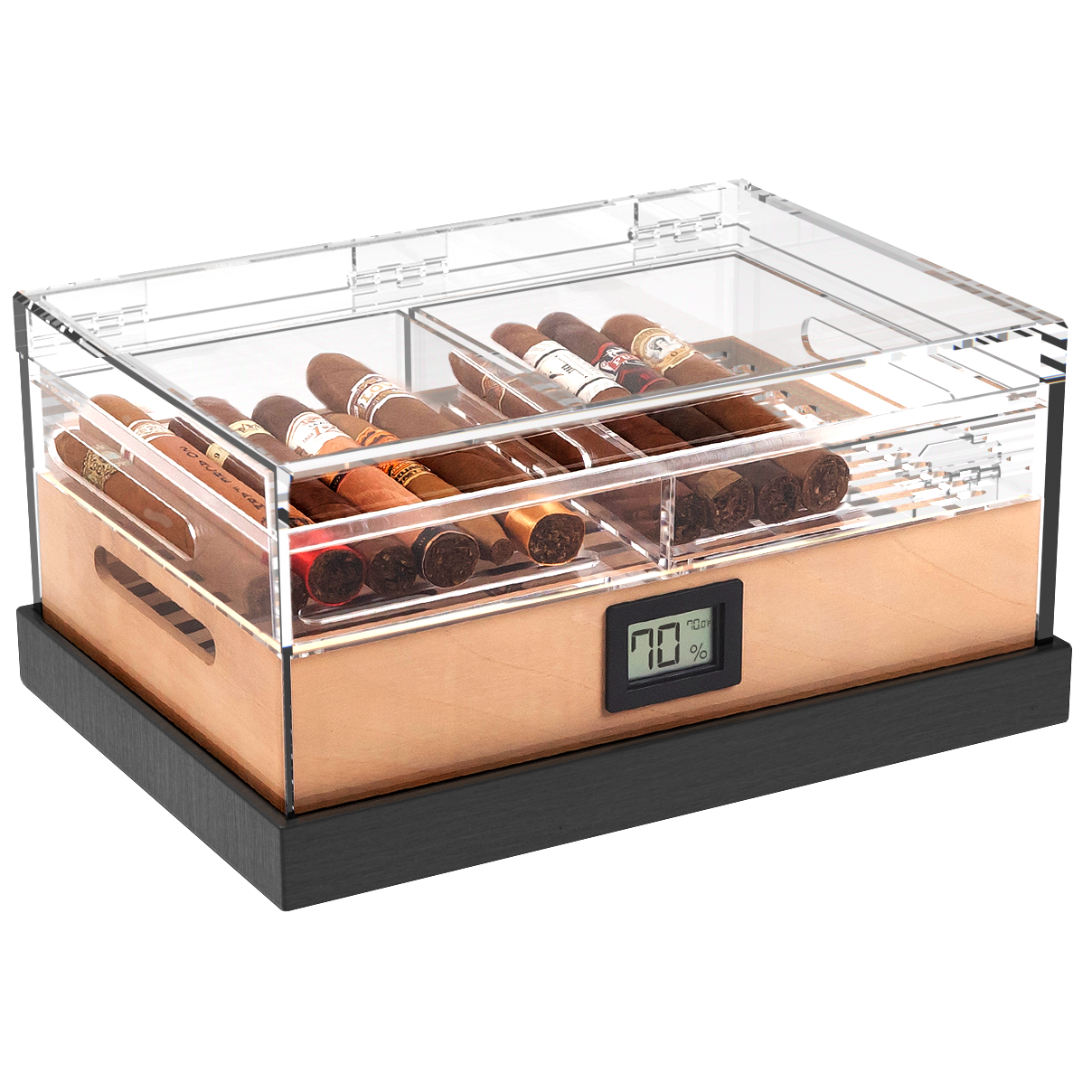
- Keep a close watch on the humidity levels inside your humidor. Many Klaro humidors have built-in hygrometers. Ideally, the relative humidity (RH) inside should register somewhere between 65–72%.
- Keep your humidor in a cool place, away from sunlight. Never allow a humidor to sit in direct sunlight, as it will raise temps and humidity exponentially.
- Routine maintenance matters. From cigar rotation to humidor solution swaps in spring and autumn, and onward to reseasoning and cleaning, staying on top of your humidor's maintenance needs is more than helpful. It's mandatory.
Parting Puffs

Like any damp room inside a home, mold control in a cigar humidor requires vigilance and due diligence more than anything. Keeping things tidy and cleaning regularly is crucial, as is routinely rotating those premium cigar blends. Keeping an eye on those humidity levels and swapping out your Winter/Dry Climate solution for the Regular Humidor solution every spring is also important, as this will keep those humidity levels from spiking during the warmer months of the year. A digital smart hygrometer, like the Klaro Valet can help you keep an eye on these things while reminding you of routine maintenance requirements.
However, if you suddenly see a spot of mold growing inside of your humidor, or on a cigar, don't panic. Contamination and clean-up are as simple as throwing away any moldy stogies and following the step-by-step quarantine and sanitation procedures listed above.
Furthermore, it is exceedingly rare for a humidor to grow so moldy that it is labeled as a complete waste. So unless you are leaving damp paper towels inside or are overfilling your Hydro Tray with Winter Solution in the midst of summer, you have nothing to worry about when it comes to humidor mold.