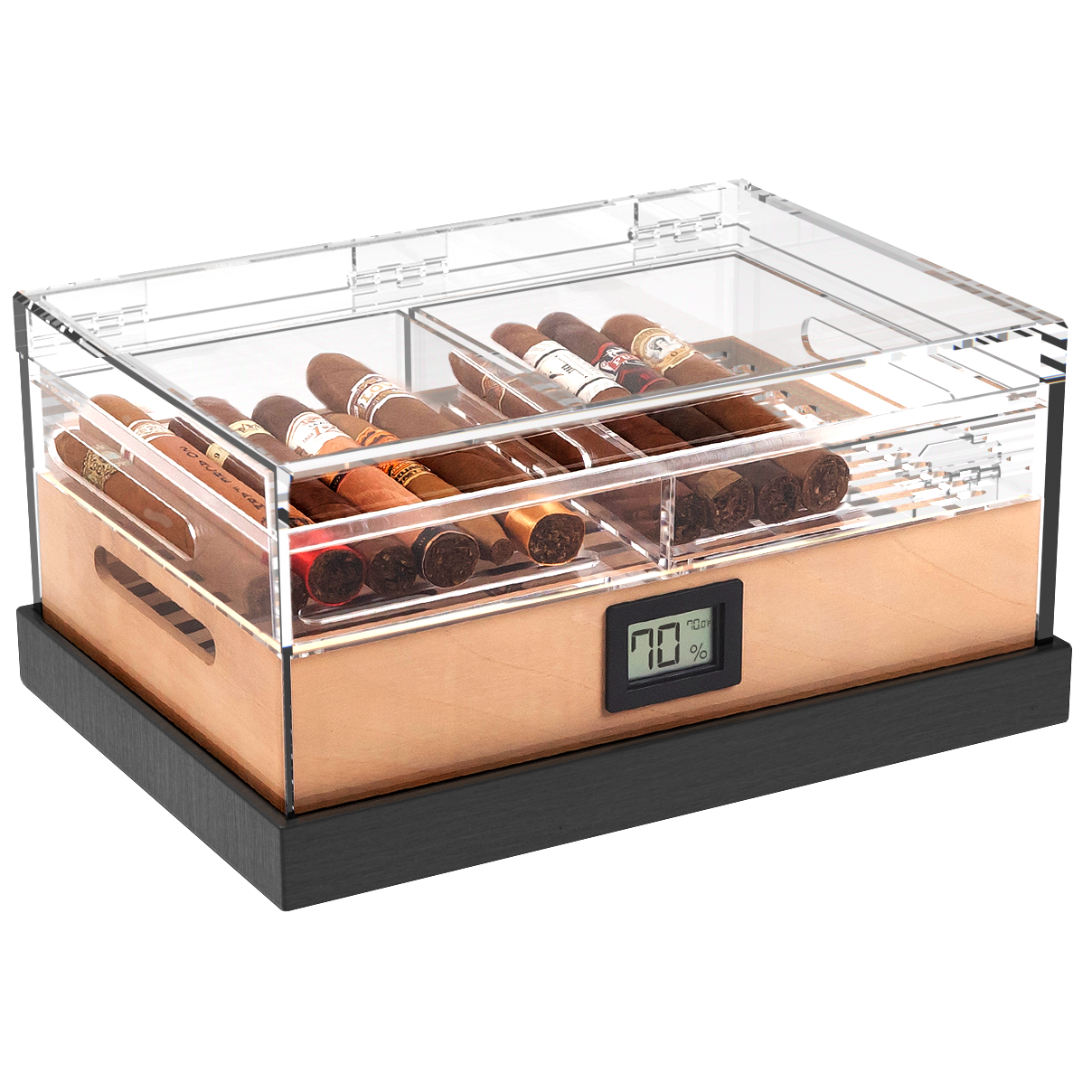
A humidor is the best way to store cigars and keep them tasting as intended and performing at their best. But without proper preparation, your humidor won’t hold the right relative humidity (RH) levels, putting your cigars at risk of drying out. This is why it is so important to season your humidor prior to placing those stogies inside its Spanish cedar-lined confines.
Seasoning is the process of preparing your humidor so that it can maintain the ideal amount of moisture and create an ideal environment for cigars so that they do not dry out or get overly humidified. Get this part right, and your humidor will perform exactly as it should straight out the gate, keeping all of those cigars in optimal condition.
We provide detailed seasoning instructions for each Klaro humidor. However, regardless of the type or brand of humidor being put into play, seasoning is a mandatory form of initial maintenance and is a must-know procedure for every cigar smoker. Hence us putting together the following tutorial, as we continuously strive to help you, the cigar smoker, understand how seasoning both improves humidor performance and cigar quality. Let's get to it, shall we?
What Does a Humidor Do?

To understand seasoning, one must first understand their humidor. A cigar humidor is more than just a handsome box to hold stogies. It’s designed to keep your cigars in excellent condition for both short and lengthy periods of time.
Without a humidor, cigars are subject to the elements around them, whether that’s extreme cold, heat, moist environments, or arid atmosphere. All of these things can wreak havoc on a cigar collection, causing them to suck up moisture and form mold, or dry out, crack, smoke unevenly, become too brittle, or not combust at all.
A properly functioning humidor should maintain a relative humidity level that’s somewhere between 65% and 72%. In these settings, a cigar will not dry out, but neither will it become laden with moisture. These humidity figures are similar to the climate where tobacco leaves are cured, fermented, and aged during the manufacturing process and even thereafter, where they are left to age post-production.
Humidors continuously regulate the internal humidity of the cigar storage chamber, so that even if you add dry cigars or open the lid frequently, an equilibrium can be quickly reestablished. But humidors require routine maintenance if they are to respond to fluctuations over time, and it all starts with properly seasoning your humidor.
Some of the perks of properly seasoning a cigar humidor include but are not limited to:
- Establishes a humidity baseline for long-term performance.
- Moistens the Spanish cedar inside so that it can slowly release humidity.
- Prevents humidity drops when you add more cigars or open the lid frequently.
- Allows an even amount of humidity to be established in every corner of the humidor's confines.
How Does Humidor Seasoning Work?

While every humidor is different, they share common components and require a similar seasoning process in order to get the humidification system, humidor wood, and cigars all working in tandem. Together, all of these components create an RH level that won’t fluctuate wildly when you add or remove cigars, open the humidor for lengthy periods for maintenance or cigar rotation, or experience temperature or humidity swings due to the changing seasons.
Inside a Klaro humidor, the wood is always Spanish cedar and at least 5mm in thickness. Our in-house-designed humidification system relies upon either a Hydro Tray, Hydro Channel, or a Humidity Pack, with moisture being provided by either our Winter + Dry Climate Solution or our Regular Humidor Solution.
Since the wood in your humidor needs to absorb enough moisture to be able to properly respond to changes in the environment, fortifying that Spanish cedar lining with enough moisture prior to adding cigars is vital. If you start storing cigars in a humidor without seasoning it, you run the risk of the Spanish cedar absorbing the moisture from the stogies themselves. That is because most humidors come unseasoned, and so that wood is bone dry and therefore quite thirsty.
Here at Klaro, we designed a unique seasoning process that works best with each of our humidors. While these methods can be applied to other humidors, there are some variations and considerations to be weighed with every cigar storage unit. So always read up on the seasoning process that is recommended for the unit you plan on utilizing for cigar storage, and you’ll reach that ideal RH level in no time.
Tobacco Nerd Note: Ever heard of a two-way humidification system? In theory, these humidification systems are supposed to mimic a properly seasoned Spanish cedar humidor's interior. These are great for short-term usage in smaller travel humidifiers, but in our research we have found that they don’t provide the optimal long-term humidity levels that a medium or large-sized humidor requires.
Steps to Seasoning a Humidor

Seasoning a humidor is not rocket science. Merely follow the steps we’ve outlined for our humidors, be thorough, and don't rush the process or try to cut corners.
That said, getting the steps right is important, and incorrect seasoning instructions abound. For example, some questionable online resources suggest simply wiping the interior with distilled water and a sponge. Putting water directly onto a dry slab of Spanish cedar lining can cause warping, which ruins the lining and lid seal, thus making it far more difficult to maintain an even level of humidity.
Each Klaro humidor includes everything you need to start the seasoning process the moment it arrives. When you register your humidor, you’ll have an opportunity to create a Klaro Membership account, which provides a year’s worth of materials to keep your humidor in prime operating form.
Getting Started

Make sure your humidor is level. You don't want excess moisture to build up in one corner of the humidor or within the Hydro System. Most smartphones have leveling apps, so make sure that the unit is on a level surface.
Wipe down all Spanish cedar surfaces inside with Klaro Humidor Solution. Use a lint-free cloth or a foam painter's brush to evenly coat all areas of the humidor's interior with humidor solution, making sure to coat the coping around the lid or door if applicable. If you live in an arid environment or it is winter, consider using our Winter + Dry Climate Solution to add extra humidity.
Initial Humidification

Add humidor solution to each quadrant of the Hydro Tray or Hydro Channel. Be careful not to overfill or spill liquid. The Hydro System doesn't need to be completely full, just thoroughly moistened.
Place the Hydro System inside, close the lid, and wait approximately 12 hours. You need to give the chamber time to absorb the humidor solution, so you can expect to see the hygrometer provide a series of different readings, gradually trending higher.
Look for 68% humidity or higher for the first few days. The initial seasoning process usually takes 3–5 days on average. If your humidor is having difficulty reaching these humidity levels, try reseasoning the interior with our Winter + Dry Climate Solution. Spanish cedar can sometimes be a bit on the thirsty side, so a secondary wipe-down might be required.
After hitting 68% (or higher) for a full 12 hours, add the gel solution packet. Sprinkle an entire packet of the included gel humidity crystals evenly throughout the Hydro System. Add more solution as needed, making sure to moisten every crystal.
Final Humidification Stage

Wait another 6–12 hours so that the gel crystals can thoroughly soak up the humidor solution.
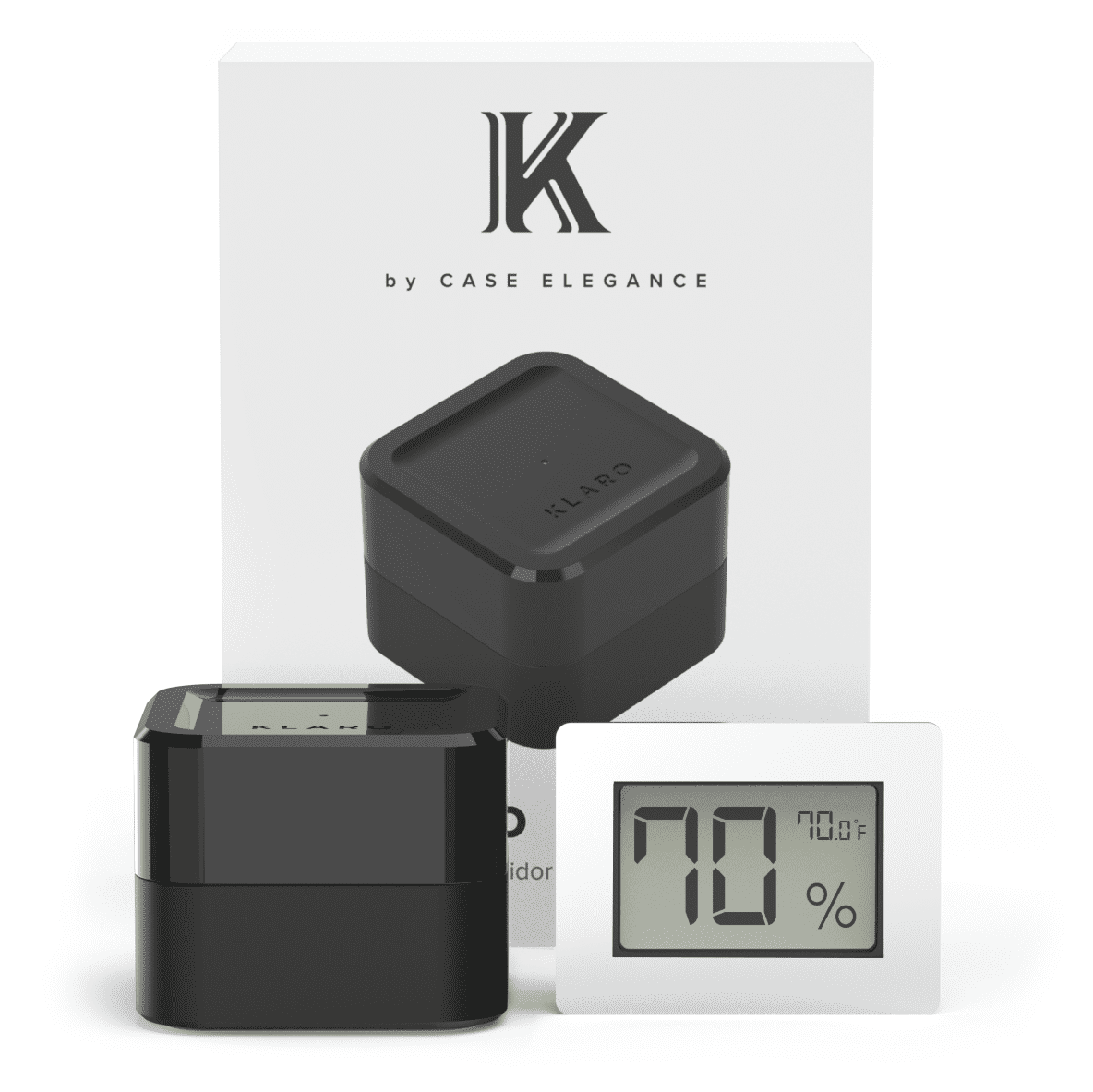
Analyze your humidity readings on your Klaro hygrometer, as it is what will measure the humidity levels and temperatures within the cigar humidor.
- If the humidity level is 70–75%, move on to the next step.
- A reading between 65–69% means you should add more solution to each quadrant.
- Anywhere below 65% means upgrading to the Winter + Dry Climate Solution.
- Readings above 75% require the removal of the Hydro System and waiting 12–48 hours while RH levels stabilize. After the recommended RH level is achieved, reinstall the Hydro System and reassess the reading after a few hours.
- Place your cigars inside. When situating cigars inside a freshly seasoned humidor, we recommend that the humidity be a bit higher, with somewhere between 67–75% being optimal. The reason for this is that cigars will soak up some of that humidity and will help stabilize RH levels.
- Periodically check to make sure humidity readings are sitting somewhere between 65–72%. Anywhere below 65% means that more solution needs to be added, while cresting 72% means removing the Hydro System for a day or two so that the humidor can recalibrate.
How to Check for Accurate Humidity in a Humidor

Now that your humidor is seasoned, you will need to make sure that it’s maintaining the proper humidity levels. Here are two key things to keep in mind when measuring humidity.
First of all, if you are using a free-standing hygrometer like what's found in the Klaro Kobi, don’t place the hygrometer directly on top of the Hydro Tray. The hygrometer is more likely to get over-saturated and read higher, so placing it somewhere around the perimeter is advisable.
Secondly, remember that your humidor will take time to adjust. The best way to measure its saturation and humidity levels is to fill it with 20 cigars or so and wait two weeks. As the cigars absorb the moist air inside, the humidity within the humidor will equalize, and you’ll be left with an accurate reading.
Parting Puffs

Once all of these seasoning stages have been completed, your cigar humidor should be showing a stable level of relative humidity around the clock. These numbers may drop or rise a point or two, but as long as the humidor is housed in a temperature-controlled environment, you shouldn't have an issue.
Failing to properly season a humidor prior to placing cigars inside of its confines, or foregoing the humidor seasoning process entirely, is a recipe for disaster. So when in doubt, reach out to your friendly Klaro customer service member and explain the situation. Not all humidors are made equal, and different cigar storage vessels require certain types of upkeep, so it is always best to err on the side of caution and do things properly. Your cigars depend upon it, and we would hate to see that precious stogie collection of yours end up in the trash.